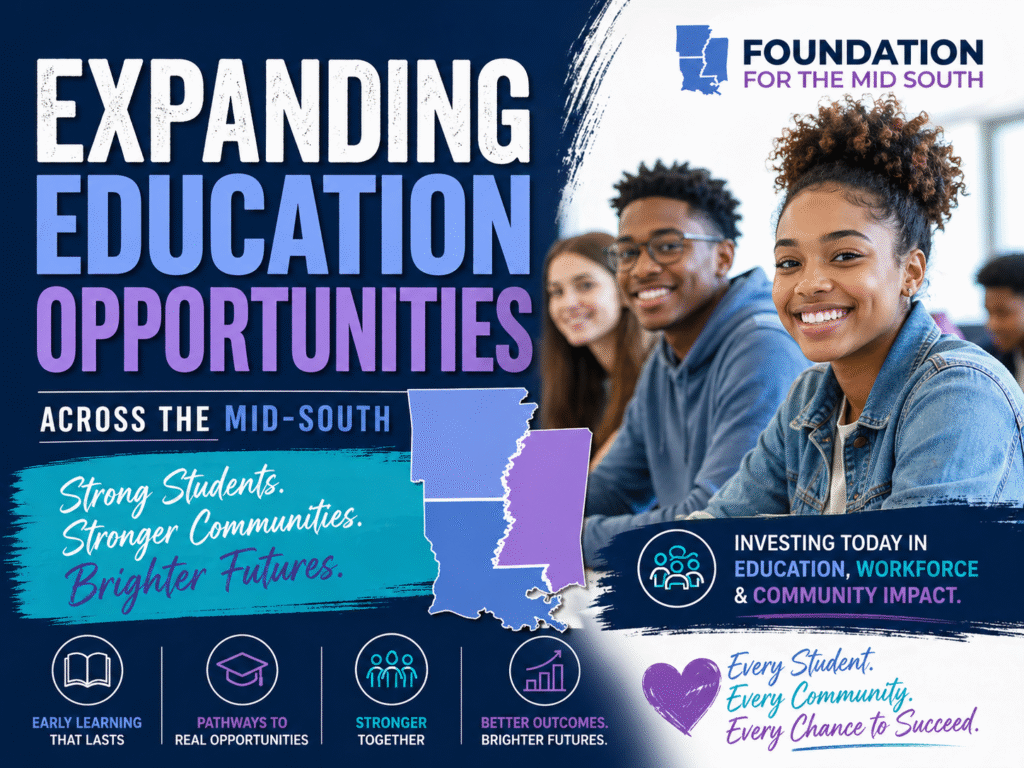
In the Mid-South, Mississippi, Arkansas, and Louisiana, education isn’t just about schools. It’s about what kind of future people have access to.
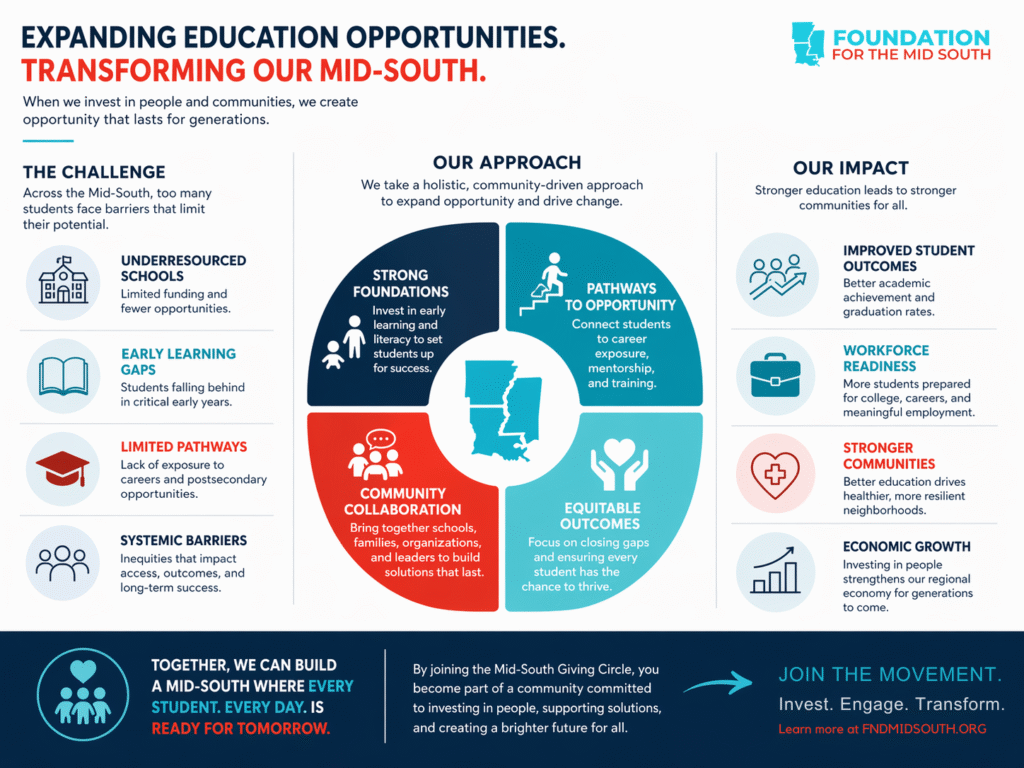
For a lot of communities in this region, the challenges are real and ongoing. Schools are often underfunded, resources can be limited, and not every student has the same level of support or opportunity. And when you zoom out, you realize education is tied to everything, jobs, health, income, even life expectancy.
That’s where the Foundation for the Mid South comes in. Their approach isn’t just about improving education in a traditional sense, it’s about creating better outcomes for entire communities over time.
It Starts Early; and It Matters
One thing that doesn’t get talked about enough is how early learning shapes everything that comes after.
If a student falls behind in reading early on, it’s hard to catch up. That gap doesn’t just stay in elementary school, it follows them through middle school, high school, and beyond.
That’s why so much of the work focuses on things like early childhood education and literacy. Not because it sounds good on paper, but because it actually changes the trajectory for students.
But it’s not just about getting kids in the classroom. It’s about what happens once they’re there.
Do they have access to strong teachers?
Are they getting the support they need?
Do they feel seen and understood in how they learn?
Those are the kinds of questions that really define whether a student succeeds.
Preparing Students for the Real World
At some point, the conversation has to shift from just “graduating” to “what happens next?”
A diploma is important, but it’s not the finish line.
Students need exposure to real opportunities. That could mean college, but it could also mean trade programs, certifications, or direct workforce training. The key is making sure they actually see those options and understand how to get there.
In a lot of Mid-South communities, that visibility just isn’t there. If you’ve never seen certain career paths up close, it’s hard to imagine yourself in them.
That’s why programs that connect education to real-world experience, internships, mentorships, career training, are so important. They turn abstract ideas into something tangible.
Schools Can’t Do It Alone
One of the biggest misconceptions is that education is only the school’s responsibility.
It’s not.
Real progress happens when schools, families, nonprofits, and community leaders are all aligned. When people are actually talking to each other, working together, and building something that fits the community, not just applying a one-size-fits-all solution.
That’s a big part of the role the Foundation plays. They bring people together. They help connect ideas, resources, and organizations that might otherwise be working in silos.
And that matters more than people realize.
Because when communities are involved, things start to shift. Students feel more supported. Parents feel more engaged. Educators feel like they’re not carrying everything on their own.
The Bigger Picture
Education doesn’t sit in its own lane.
It connects directly to health, to income, to stability. When education improves, other things tend to follow. People have better job opportunities. Communities become more resilient. Long-term outcomes start to change.
That’s why the focus isn’t just on schools, it’s on systems.
The goal is to create an environment where education, health, and economic opportunity all work together instead of against each other.
What Comes Next
There’s progress happening, but there’s still a lot of work to do.
Expanding education opportunities in the Mid-South isn’t going to come from one program or one initiative. It’s going to take consistent investment, stronger connections between education and workforce systems, and a real commitment to closing the gaps that have existed for years.
More than anything, it takes a shift in mindset.
The belief that every student, no matter where they’re from, should have access to real opportunity.
Final Thought
Education has a ripple effect. When you invest in it the right way, it doesn’t just impact students, it impacts families, communities, and future generations. And that’s really what this work is about. Not quick wins. Not short-term fixes. But building something that lasts.