When people talk about gun violence, the conversation often starts in the same place: crime, courts, arrests, policing. But that framing only tells part of the story. It leaves out the anxiety a student carries into the classroom after another lockdown drill. It leaves out the mother who sits through years of court proceedings and still walks away feeling unheard. It leaves out the trauma that lingers long after the headlines fade.
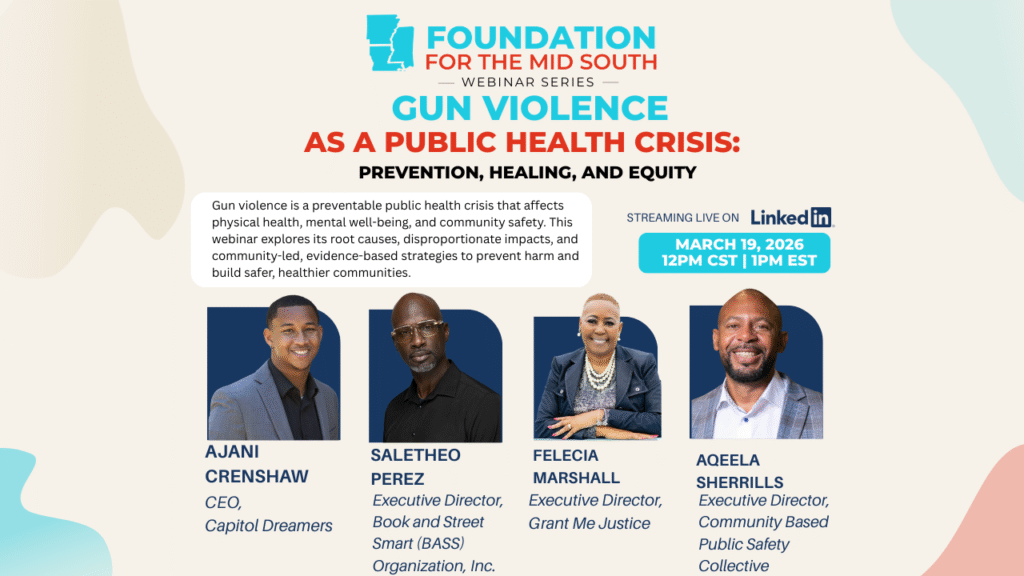
That fuller story took center stage during the Foundation for the Mid South’s recent webinar, Gun Violence as a Public Health Crisis: Prevention, Healing, and Equity, where moderator Aqeela Sherrills and panelists Ajani Crenshaw, Felicia Marshall, and Saletheo Perez challenged viewers to see gun violence not as a single-system problem, but as a crisis that touches mental health, family stability, education, and the overall well-being of communities. As Sherrills put it, gun violence is “a preventable health crisis that affects physical safety, mental health, community stability and economic well being.”
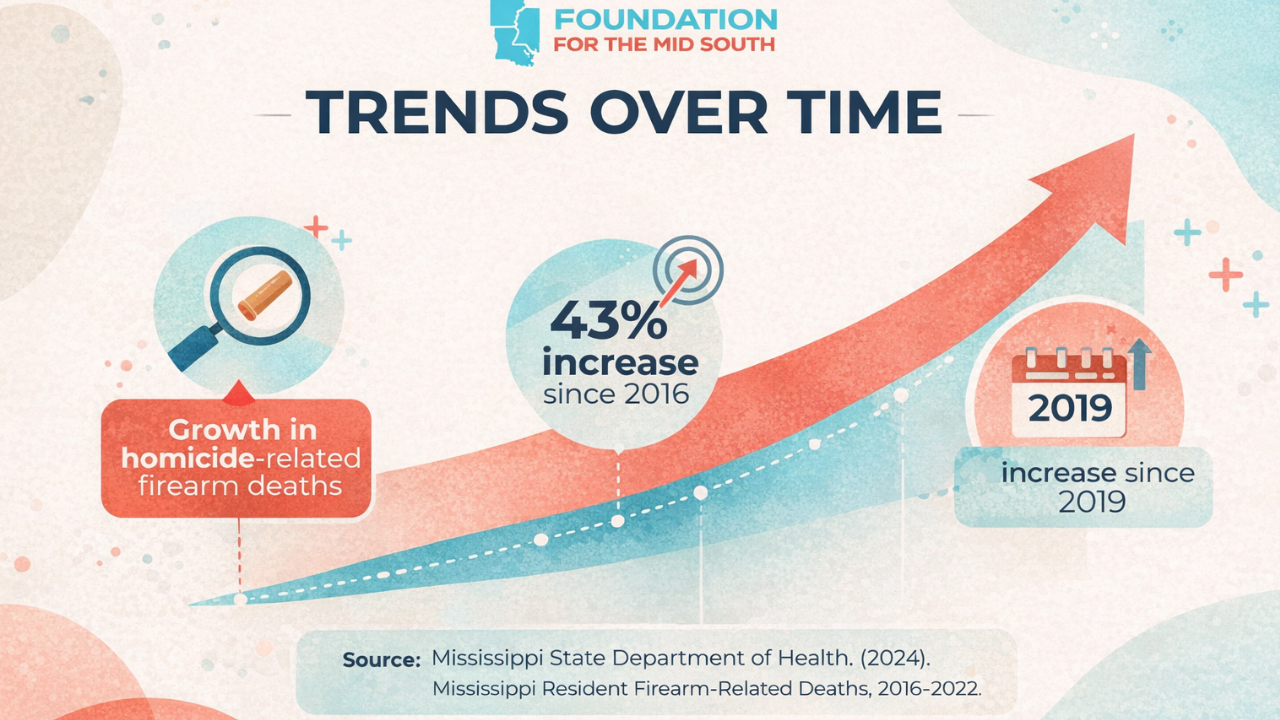
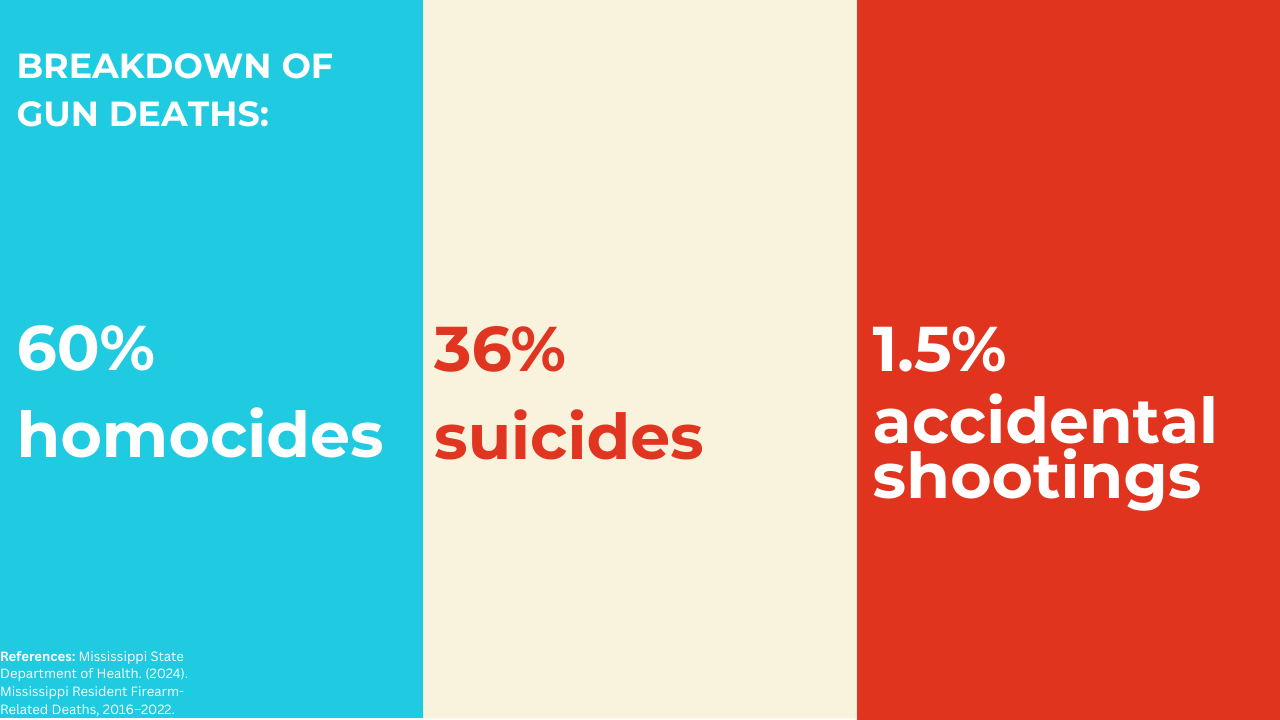
The stakes in Mississippi are hard to ignore. During the discussion, Sherrills noted that 849 people in Mississippi died from firearm-related injuries in 2022, giving the state a firearm death rate of 29.6 per 100,000 residents, the highest in the nation according to the statistic cited during the webinar. She also pointed to the uneven burden of violence, saying young Black men ages 15 to 44 are disproportionately affected in communities already facing systemic barriers.
That framing mattered. It moved the conversation away from the tired, one-note playbook and toward something more honest. If gun violence is a public health crisis, then the response has to be broader too. Not just punishment, but prevention. Not just enforcement, but healing. Not just reaction, but investment.
What young people are carrying
Ajani Crenshaw, a student at Tougaloo College and CEO of Capital Dreamers, spoke with clarity about what many young people are living through, even when adults fail to name it.
“What I see from young people is a big problem, because they don’t really understand how gun violence really is affecting their lives, because simply, it becomes so normalized in our society,” Crenshaw said.
He described a generation growing up with lockdown drills, constant exposure to shootings in the news, and even the sound of gunfire in their own neighborhoods. “When it comes part of our regular life… it changes how we necessarily think, how we move and how safe we feel every day.”
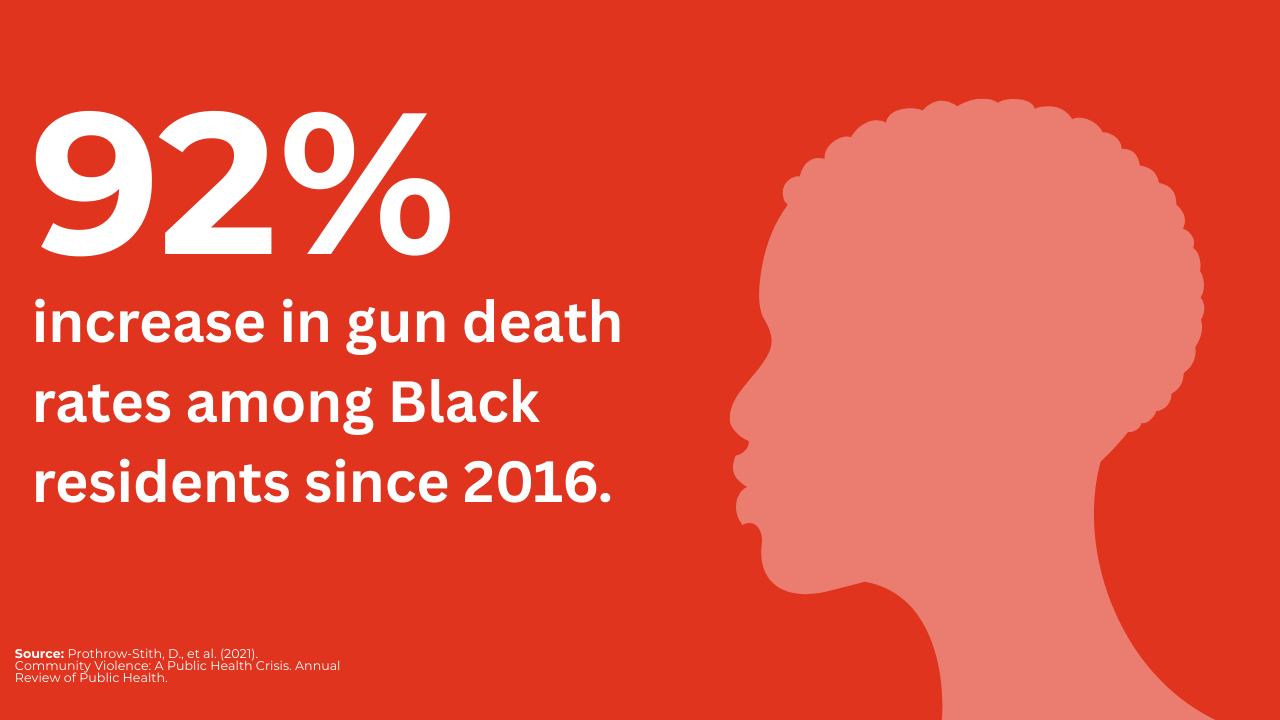
His point landed because it was not abstract. He tied violence directly to learning, emotional well-being, and development. Students, he said, struggle to focus in classrooms when safety is always in the back of their minds. Anxiety, grief, and trauma can show up as disengagement, behavior issues, and disconnection from school.
Crenshaw also pushed back on the idea that young people should simply be invited into the room as a gesture. He made the case for real participation, not tokenism. Youth, he argued, should not just be present in conversations about violence prevention. They should help shape the policies that affect their lives. Later in the discussion, he said one of the biggest needs is “more empathy within everything that we do,” adding, “Why can’t empathy be a part of the system? We are people. We are humans.”
There is something plainspoken and powerful in that question. Why can’t empathy be part of the system? It is the kind of line that sticks with you because it sounds so obvious and yet, too often, so absent.
The loneliness survivors know too well
If Crenshaw brought the perspective of youth, Felicia Marshall brought the voice of survival, grief, and the long road toward justice. Marshall, executive director of Grant Me Justice, founded the organization after her daughter was murdered in 2017. Her remarks cut straight to the emotional and structural gaps families face after homicide.
“Walking away from that process, I felt like I had left something on the table,” Marshall said of the years she spent seeking justice. “I felt like that the state of Mississippi did not represent me or give me a voice in the criminal justice process.”
She described the experience as one of the loneliest processes of her life. Not only because of grief, but because the system itself offered so little room for survivors to be seen, heard, and supported. Trauma counseling, she said, was not optional. It was necessary. Some images, some moments, simply do not leave you.
Later, when asked what healing looks like for families affected by gun violence, Marshall offered one of the most memorable reflections of the webinar. “I think the most powerful thing, if anything, that Grant Me Justice offers, is the fact that we don’t forget because the world keeps moving, but Grant Me Justice, we remember.”
That line gets at something many survivors know in their bones. The world moves on. Calendars flip. News cycles churn. But grief does not keep office hours, and it does not politely disappear. Marshall said healing looks different for each person, but stressed the power of shared space, shared understanding, and being surrounded by others who know what this kind of loss feels like. “We’re growing together. We’re falling apart together. We’re being strong together. We’re fighting for justice together.”
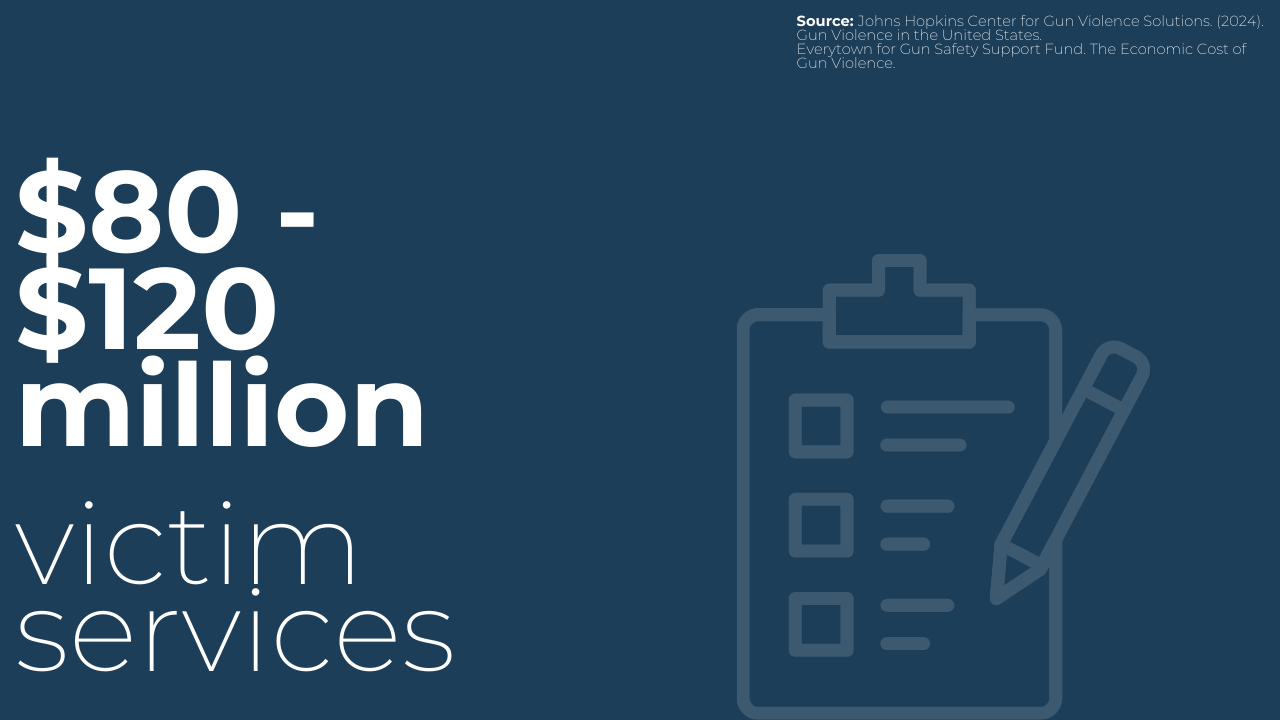
Her message was clear. Any serious response to gun violence has to account for what happens after the sirens, after the court dates, after the casseroles stop coming. It has to include the families left to navigate grief, bureaucracy, and memory all at once.
Prevention that starts in the community
Saletheo Perez, executive director of Books and Street Smarts Organization, brought another essential lens to the conversation: lived experience. Having spent two decades incarcerated, Perez spoke candidly about trauma, conflict, and what communities often overlook when trying to interrupt cycles of violence.
“One of the root causes of violence… that is overlooked is the trauma informed care that is needed,” Perez said.
He also pointed to the lack of conflict resolution skills and the way children are often taught to respond physically to disrespect or rejection without ever being taught how to walk away, de-escalate, or process emotion.
Perez did not sugarcoat it. He argued that community-based organizations are often best positioned to do work traditional systems struggle to reach. Why? Because trust matters. Familiarity matters. Credibility matters. “We are literally the root to what’s going on in our community,” he said, explaining that peer education works because people listen differently to someone who has lived what they are trying to prevent. “Any information that I gained is information that I paid for already. There’s no need for somebody else to have to go pay the same price that I paid.”
That is a hard-earned kind of authority, and it helps explain why grassroots organizations are often able to reach people who are skeptical of institutions, disconnected from services, or simply tired of being talked at by folks who do not understand their reality.
When asked what strategy could make the greatest difference in reducing gun violence, Perez answered with one word: openness. Communities, he said, need more honest conversations about lived experience, about how violence takes root, and about how guns move into neighborhoods in the first place. “We need to use openness and allow our past to really educate, to see a better future.”
That kind of honesty is not always neat. It is not always comfortable either. But that was part of the webinar’s larger point. You cannot heal what you refuse to name.
A broader view of public safety
Throughout the conversation, Sherrills kept bringing the panel back to a broader definition of public safety. One of the webinar’s strongest through lines was the argument that public safety cannot be reduced to policing alone.
“We constantly hear that public safety equals police,” he said, before pushing back on that narrative. Police, he noted, are one part of the ecosystem, but not the whole thing. “Public safety is not just the absence of violence and crime either. It’s the presence of well being and the infrastructure to support victims and survivors.”
That framing changes the questions communities ask. It asks whether people have access to counseling, credible messengers, supportive schools, victim advocacy, safe spaces for healing, and pathways for reentry. It asks whether young people feel heard. It asks whether families can find help at midnight, not just during office hours.
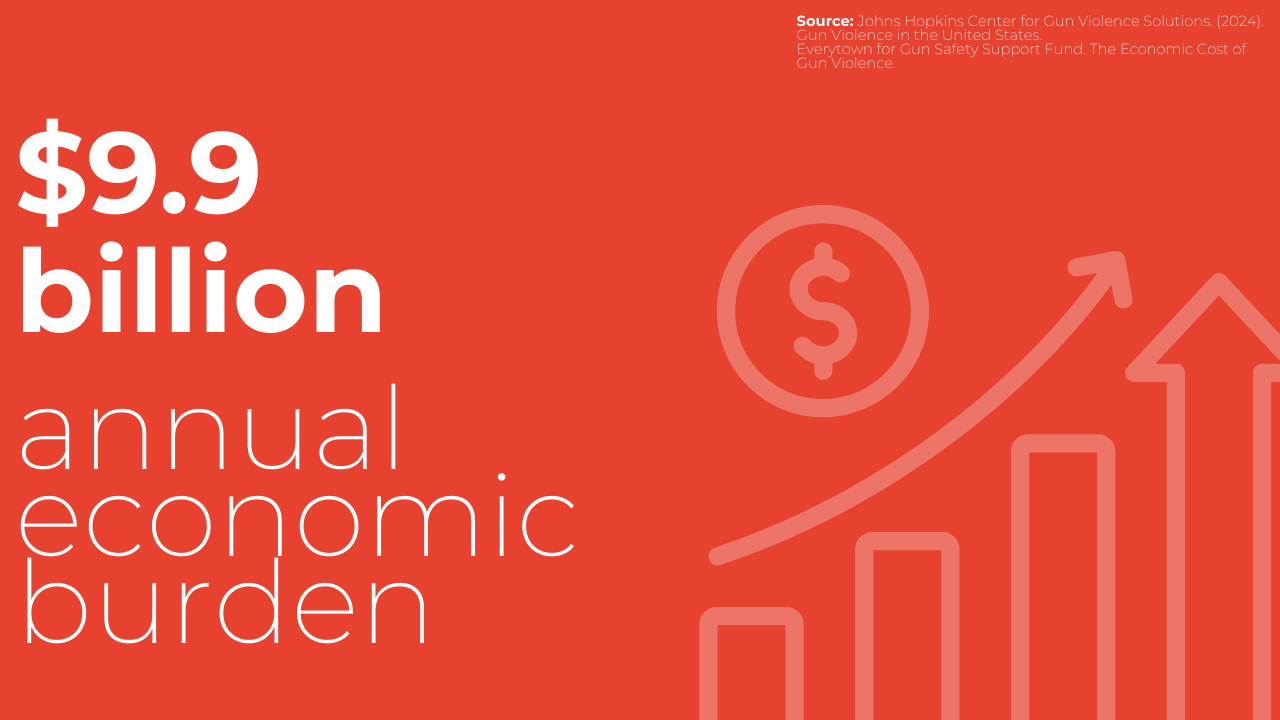
Sherrills also highlighted a major effort underway in Jackson, where he said one of the country’s largest social impact investments is being directed over the next five years toward community violence intervention infrastructure, victim advocacy, trauma recovery services, and mental health response. The goal, he said, is to help build “a strong ecosystem for safety in the city.”
That language is worth sitting with. An ecosystem for safety. Not a single solution. Not a silver bullet. An ecosystem.
What the path forward demands
By the end of the webinar, no one was pretending there is an easy fix. But the conversation did point toward a different kind of roadmap, one grounded in empathy, survivor support, youth leadership, trauma-informed care, civic education, and real investment in community-rooted organizations.
There was also a quiet but unmistakable insistence that people are more than the worst thing that happened to them, or the worst thing they have done. That belief threaded its way through the whole discussion. It was there in Marshall’s insistence that survivors need voice and care. It was there in Crenshaw’s push for empathy and youth participation. It was there in Perez’s belief that lived experience, honestly shared, can become a tool for prevention instead of a life sentence of silence.
As the webinar closed, Sherrills left listeners with a reminder that felt both urgent and hopeful: “Gun violence is not inevitable.” It is preventable, he said, when communities, public health leaders, and policymakers work together.
That may be the clearest takeaway of all. If gun violence is a public health crisis, then prevention is not somebody else’s job down the road.
It is community work. It is policy work. It is healing work. It is the work of building systems that do not just respond after harm, but help keep harm from happening in the first place.
And around here, that is not just talk. That is the work.